Written by


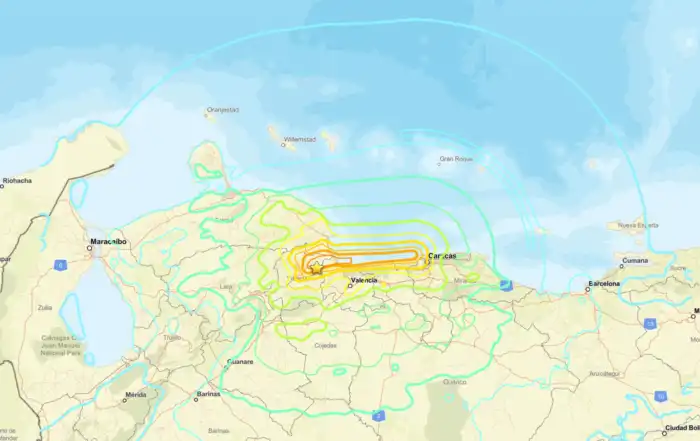
At 18:04 local time on 24 June 2026, northern Venezuela was struck by a major earthquake initially reported by the USGS as magnitude 7.2. About 39 seconds later, a second, larger M7.5 event occurred nearby. The epicentral area lay around San Felipe and Morón, within the Yaracuy–Carabobo region, roughly 160 km west of Caracas. USGS solutions placed the two shocks at shallow depths of about 22 km and 10 km, respectively. Given the less-than-a-minute separation, magnitudes, depths and the interpretation of the sequence may be further refined as more data are reviewed.
The close timing makes this an unusual and scientifically important sequence. It may ultimately be described as a foreshock–mainshock pair, a seismic doublet, or two major pulses within a complex rupture. What is already clear is that the M7.5 shock released substantially more energy than the first event and produced severe shaking across a densely populated corridor. Tremors were reported throughout Venezuela and in parts of Colombia and Brazil.
The humanitarian impact is still developing. Early on 25 June, Venezuelan authorities reported at least 32 deaths and 700 injuries, with the figures excluding severely affected La Guaira at that stage. Buildings collapsed in Caracas and other communities; power and communications were disrupted; Simón Bolívar International Airport was closed; and a national state of emergency was declared. A regional tsunami threat message was issued shortly after the earthquakes, then cancelled once the threat had passed.
The sequence occurred within the broad boundary zone between the Caribbean and South American plates, where deformation is distributed across major strike-slip fault systems. Shallow crustal earthquakes in this setting can generate intense ground motion close to the source, while local soils, topography, construction quality and structural irregularities strongly influence damage.
For structural engineers, the immediate priorities are rapid safety assessment, controlled access to damaged buildings and continued monitoring during aftershocks. Structures that have lost stiffness, strength or load-path continuity may be especially vulnerable to subsequent shaking. In the longer term, recorded motions and field observations should support nonlinear response-history studies, fragility assessment and calibration of loss models for reinforced-concrete and masonry construction.
Open, rapidly updated datasets are essential for independent verification and engineering decisions during response, recovery and planning. This disaster is a stark reminder that seismic resilience depends not only on hazard maps, but also on code enforcement, retrofit programmes, emergency planning and transparent access to high-quality data for safer future communities.
Seismological data
- USGS first shock — event us6000t7zc: origin parameters, felt reports and technical products.
- USGS M7.5 event — us6000t7zp: event summary, ShakeMap and downloadable products.
- USGS PAGER assessment: modelled shaking consequences and loss estimates—not confirmed casualty totals.
- USGS moment-tensor solution: seismic moment, Mww and source parameters.
- EMSC reviewed solution: independent event parameters and felt reports.
- FUNVISIS: Venezuela’s national seismic service.
- INGV rapid scientific analysis: discussion of the closely spaced sequence.
- GDACS and PTWC tsunami messages: initial threat messages and subsequent cancellation.